
According to Dean Young, anyway, may he rest in peace. It comes from The Art of Recklessness, which is a treatise on surrealism and creativity gone mad, guised up as a notes-on-craft poetry book. Like a lot of his work, it reveals a zigzag alchemy of high and lowbrow. Ariosto yin, whoopie cushion yang.
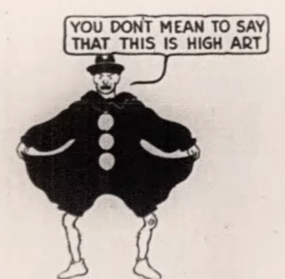
And my cup runneth over. Because the things I'm drawn to are usually either mischeviously-clever lowbrow, or they're lofty canonical things which can't help themselves but to say pull my finger. So that's the first side of the quote above which I want to examine, the idea of distinct things in relation. The second is the sense of becoming-something-else. To lay my cards bare, at the time of this writing, I'm in a deep-dive on dialectics, and I've learned that apparently Hegel was a comedian? It fits, because what I suppose I'm recognizing are internal contradictions, and I've always found them in skateboarding, Björk, Fleischer toons, in Jackass of course,1 you name it.
Getting to my main example though, it's in Fellini too. I do usually keep movies at arm's length2, but I've always been spellbound by him. Although I've never had much exposure to him aside from falling asleep every single time I've attempted to watch 8½.
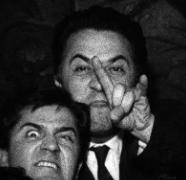
But then recently I saw La Strada. Guilietta Massina (Fellini's wife) plays a poor young woman named Gelsomina who gets sold off to a total bastard circus strong-man named Zampanò. He bought her sister previously, but she died while with him, and he returns to the family and purchases Gelsomina to be his new assistant. Throughout, Massina's eyes alone run the whole gamut across tragicomedy, and she draws your sympathies right up out of you. I had no idea that Fellini was making such completely brutal movies. I'd assumed his characters were just illusioned rich people, and I guess I have his wife to thank for snapping me out of it. Nights of Cabiria too, uffda. Both films are totally cruel, but Massina has a peculiar and confronting humanity to her. In La Strada, right when she's making new circus friends, one of them turns and says to her: What a funny face. More like an artichoke than a woman. (Oof) Her expression flips in an instant; one second she's glowing with a sense of possible and better worlds, and then the next second she's totally deflated, slumping away like Eeyore. However, as Cabiria, lost and having lost everything, she remains indomitable.
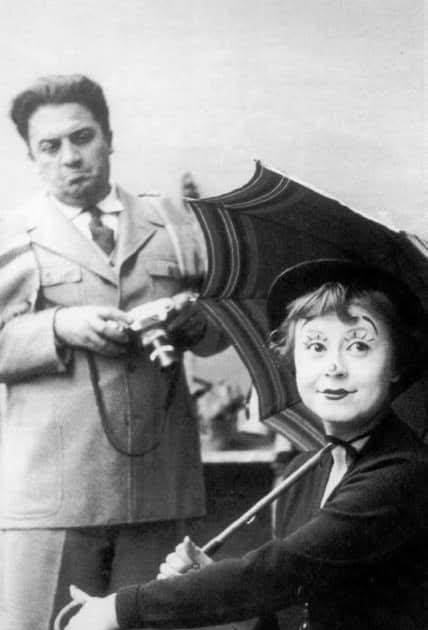
I was dumbstruck at how both these movies pummel Massina, and yet how she somehow triumphs in each of them. Maybe her nonverbal communication is just that convincing, and maybe her physicality is the connective tissue that likens these works to the more, ahem, humble media forms in my mind: I'm immediately reminded of Chuck Jones on facial expressions--they're the one part of us that's always alive, conveying everything. It's certainly true in Massina's case. And as we know, Jones stretched that logic like a fresh pulled noodle, allowing his cartoons to traverse emotion, history, genre, the broader humanities, ad slaphappy nauseum.
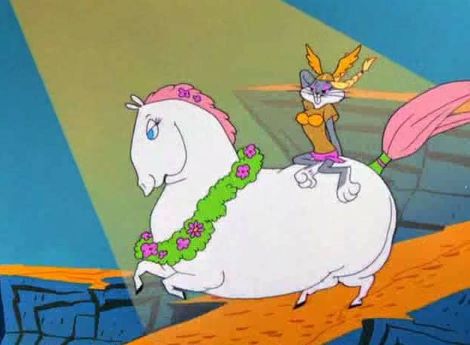
So, this is all what makes me think of the dialectic. I find certain contradictions implicit in the energy (a very bodily energy) in these things I've been talking about, like skateboarding, slapstick, and Italian Neorealism, and it leads me straight back toward people like Spinoza or Hegel. Although admittedly my grasp on Hegel is still tenuous so please be gracious with me.3 Or is this what the carnivalesque is?4 Wagnerian opera à la Bugs Bunny in drag? Koko the Clown possessed by Cab Calloway and eulogizing Betty Boop? As far as my personal investment is concerned, who really cares. I'm not writing a thesis again and at the end of the day, the payoff for me is plain fun. These things complement each other and I can't help of find it all incredibly rich and rewarding.
And so I maintain that Bugs Bunny and Buster Keaton and Cervantes all bump into each other at the joke shop. They reach for the same things5 with the same harebrained vigor which nyuk-nyuk-nyuks straight through Dean Young's books, through Joyce, and through otherwise-blindingly-moronic skateboarders rigging up spots like Rube Goldberg. Arts of recklessness indeed.
1. I actually did some of my graduate work on how, in my view, Jackass weds traditions from classic Hollywood, camp, and skateboard aesthetics all together and how different design modalities are built into it. After all, it was created by skaters, artists, and Spike Jonze. Eventually, I interviewed the International Buster Keaton Society about all this, although unfortuately shortly after, my university went on strike and my classes all suddenly ceased, and that material never finished. In time I'd like to come back around to it.
2. Annoying many friends and family, I first went on a movie "hiatus" in 2019, which was kind of nuts since suddenly we all went into lockdown, never to be screen-free again. And then in 2024 I finally read Amusing Ourselves To Death, and that sealed the deal. I do still watch old slapstick stuff and partake in one film club, but for the most part now, as movies go, I remain pleasantly aloof.
3. I do know enough, though, to know that what I'm talking about isn't thesis-antithesis-synthesis, which I believe actually comes from Fichte and not Hegel. What I am driving at is not a two-things-become-one-thing phenomenon either, but rather that things in themselves uniquely contain contradictions, which is how Spinoza fits in too.
4. The 19-year-old English major pretends to understand Bakhtin.
5. One last bit: a few years ago I saw Antonio Lizana in Jackson Heights, and during the set he said Camarón de la Isla and John Coltrain pursue the same thing, and you can tell he takes it to heart.